The International Criminal Court is raising a hell of a storm across Africa. There are current investigations and/or indictments in Uganda, Sudan, Ivory Coast, DRC, Central African Republic, Kenya and most recently Libya. The fact that most of its current energies are focused on Africa has led to a disturbing discourse, promulgated by the powers-that-be, that the ICC is in some way "targeting" Africans.
This is very sad. It seems to me that it is an entirely good thing for people everywhere that there is an independent body able to investigate alleged crimes against humanity and bring charges against parties involved. And it also seems to me that we ought to be able to put narrow-minded nationalistic concerns behind us and wholeheartedly support the ICC's aims and activities.
To those, therefore, who complain that the ICC is anti-African, the logical response is to say that in fact it is pro-African, as it devotes so much of its time and resource to investigating alleged crimes on the African continent, and seeks to bring justice to the African victims of these crimes. It is also worth pointing out, as an aside, that the ICC is intended to be a court of last resort, which investigates and prosecutes only where national judicial systems and processes have failed, and that instead of complaining about the ICC it would be better by far to complain about the weaknesses in many African judicial systems - and then do something about them.
But these arguments usually fall on deaf ears, for the very human reason that we can all agree about a good thing when it happens somewhere else. The ICC is a wonderful organisation - as long as it's not going about its business in my back yard!
Tuesday, January 24, 2012

Saturday, January 21, 2012
Coffee's coming home
 The slogan for the European Championship football tournament held in England in 1996 was "Football's coming home". Well, the global love affair with coffee is coming home to East Africa where, with the honourable exception of Ethiopia, consumption of the region's most famous indigenous export crop has been very low.
For many years, it was quite hard to get a good cup of coffee in East Africa, outside the major hotels, high-end restaurants and tourist lodges. Instant coffee prevailed, more often than not in the shape of the tasteless brown powder of the Africafe brand. Now, there are a slew of entrepreneurs establishing coffee houses and chains in the major cities across East Africa. The trend started with the hugely successful Java brand in Nairobi, followed by Dormans (also Nairobi), Good African Coffee (Kampala) and my own personal favourite, the beautifully-branded Msumbi Coffee (Arusha and Dar). Better still, coffee prices to the farmer for both arabica and robusta are shooting through the roof, providing farmers with the incentive needed to invest in replanting their coffee fields with higher-yielding seedlings. The picture above shows a coffee nursery in the prime coffee-growing area close to Kilimanjaro.
Five years ago, I attended the East Africa Fine Coffee Association (http://www.eafca.org/) annual conference in Addis. It was a cheerful and friendly event, which provided plenty of opportunity to enjoy the traditional Ethiopian coffee ceremony and discuss the prospects for the industry in the region. Back then, only the most optimistic could have foreseen the market growth in the region and the price growth on international exchanges. I'm very sorry not to be attending this year's EAFCA renewal back in Addis, where coffee aficionados will again be coming home under far more celebratory circumstances.
Monday, January 16, 2012
The Haven in Jinja

Here's a nice shot of the Pearl Capital Partners advisory team, taken this Saturday on our annual staff retreat. We went to the Haven, a lovely place on the west banks of the Victoria Nile near Jinja, overlooking the rapids.
Just like the Norman Carr Cottage in Malawi, the Haven manages to be a delightful place to stay without standing too much on ceremony. Everything is good: both the location and the home-baked bread are both among the best in Uganda. There's a pool table, a volleyball court and no need of a swimming pool with the river right below. The cottages are comfortable and the staff pleasant and efficient.
It is to be recommended to any visitors to Uganda in search of a haven for a few days. Excellent.
Sunday, January 8, 2012
New Year with Bebe Cool and friends

What to do on New Year's Eve? This is a difficult question for non-Party-goers like me, so I was delighted to see that the Jamaican duo Chaka Demus and Pliers were playing at the Speke Resort in Munyonyo, just round the corner from my Ggaba home. This passed my various tests for an enjoyable evening out: nearby (therefore little risk of Kampala traffic jams); outdoors (slightly lower noise levels combined with fresh air and easy escape routes); and professional musicians playing real music (rather than the lip-synching that passes for live music at many Ugandan shows).
Chaka Demus and Pliers had a string of hits in the 1990s. My personal favourite was their reggae/rock n'roll rendition of Twist and Shout, but Tease Me, Murder She Wrote and She Don't Let Nobody were all great songs. So, for a mere 50,000 shillings (about $20 at current exchange rates) for the VIP enclosure, plus a fireworks display and a string of curtain raiser performances from up and coming Ugandan musicians, it sounded like good value. The key words here are, of course, "sounded like". I had forgotten that Ugandan promoters are at least as unreliable as promoters everywhere else in the world. This show was promoted by Moses Ssali (pictured above) a.k.a. Bebe Cool, one of Uganda's best-known and most popular musicians and son to the politician Bidandi Ssali, who stood unsuccessfully for the Ugandan Presidency last year. Bidandi's campaign slogan was "Trust Me": the electorate responded with less than 1% of the popular vote.
After spending an hour negotiating the three kilometres from home to Munyonyo (due entirely to rigorous searching of every vehicle entering the Speke Resort), we arrived shortly after 9 pm, by which time a few acts had started to appear on stage. The MCs for the show were two appallingly unfunny comedians, whose main joke line in between acts focused on the ways in which women from different Ugandan tribes behave during - how shall I put it? - moments of intimacy. Enough said! The intervening music wasn't much better, ranging from moderate to abysmal. But to their great credit, Ugandan audiences are in general very forgiving, and this one was no exception: happy enough with the entertainment on show and why not? Plenty of alcohol was flowing, the evening was warm and dry, with the promise of better things to come.........
As the clock approached midnight, and there was no sign of Chaka Demus and Pliers, I felt the first twinges of anxiety. Were they actually going to perform? The fireworks came and went, the old year was gone and the new year started, the MCs continued to heckle the audience, the audience gradually became more irritable at the delay, until Bebe Cool himself turned up and performed a few songs. It took until a little after 2 am for Pliers, or (at the risk of being excessively suspicious) someone claiming to be Pliers, to come on stage and announce that in fact Chaka Demus hadn't actually turned up. Pliers (or the man who claimed to be Pliers) then played four or five songs - which notably did not include any of the duo's most well-known hits - before finishing up at around 3 am. And was there any apology from the MCs or the promoter? Silly question, really. After all, apologies require respect for others, and respect for others is, on the whole, a commodity in short supply among Uganda's elite.
Being conned is hardly an auspicious start to the New Year. Oh well, at least Bebe Cool's still laughing. We all came, paid for our tickets, and he didn't need to pay the main act. Nice work if you can get it.
Friday, January 6, 2012
Open Sesame

Anyone familar with the story of Ali Baba in the Arabian Nights will remember that the password to the thieves' cave was 'Open Sesame". When I was first told the story, back in 1970s pre-McDonalds Britain, I had no idea what sesame was, but the globalisation of cuisine has changed all that. Now I know the delicious taste its seed imparts to middle eastern favourites like hummus bi tahini and baba ghanoush, among others, and the delicate flavour of its oil in many Asian dishes. I also learned that sesame is in fact one of the oldest crops cultivated by humankind, dating back to the Babylonian era. It was perhaps the most valuable oilseed in the ancient world because of its tolerance to drought, its high oil content (about 50% oil), the ease of oil extraction and its stability.
I didn't know much about sesame cultivation until my recent hot and dusty road trip to North West Uganda, where, along with cotton, it is an important cash crop. Sesame (usually called by its Arabic name of Simsim) is very often grown in tandem with cotton: it is drought-tolerant and withstands high temperatures. It makes an excellent rotation crop for cotton as it has different nutritional requirements and it suppresses two significant cotton pests, root rot and nematodes. Several of the cotton farmers we visited were also growing simsim, harvesting manually and allowing the cut plants to dry off in bales (pictured above) to reduce the risk of crop loss resulting from seed pod shattering while in field. In the USA, plant breeders have developed simsim varieties which are not prone to shattering, but these are not yet available in Africa.
Saturday, December 31, 2011
Plus ca change
I have a book on my bookshelf entitled "Realizing the promise and potential of African agriculture". It was published in June 2004 by the Inter Academy Council, following intensive research and consultation in 2002-2003. I found it very useful when I began to develop the investment strategy for African Agricultural Capital in 2005. Well-researched, well-written and well-intentioned, it sets out a shopping list of recommendations that, taken together, will achieve the goal expressed so concisely in the title of the book itself.
Some eight years later, I wonder how many of the recommendations have been acted upon and how much change has taken place for "the man [and woman] with the hoe", which remains the best description of the average African farmer. Certainly, some progress has been made. For example, more African farmers have access to certified seed. Information and communication technologies are infinitely more accessible than they were, as a result of the rapid spread of wireless communication. Rural infrastructure has, in general, got slightly better. Import statistics, at least in East Africa, suggest that the use of fertiliser and crop protection inputs has increased.
Otherwise, however, I suspect that very few elements of the plan have been implemented. Indeed, at the risk of being cynical, I'd hazard a guess that you could repackage and republish the recommendations without anyone noticing that they were first issued eight years ago, and, perish the thought, that you could probably do the same again in 2020....... Worse still, it's already happened, more or less, in the form of the Comprehensive Africa Agriculture Development Programme (fondly known as CAADP to its friends).
Why is it that the very well-qualified people that populate the corridors of academia and administrations around the world persist in believing that plans translate into action, when there is so much evidence to the contrary? In his provocative book, The White Man's Burden, the rogue World Banker Bill Easterly argues very strongly that "Planners", at least with regard to foreign development aid, have failed, and that the real agents of change are what he describes as the "Searchers", the people who experiment, who learn from experience what works and what doesn't. He might have described them as "Doers". Easterly is by no means alone in his critique, Charles Dickens and Mark Twain satirized planners and do-gooders more than a hundred years ago. Graham Hancock exposed the hypocrisy and waste in the aid industry in his modern classic The Lords of Poverty. Dambisa Moyo added her voice a few years ago in Dead Aid. And Michael Maren provides anger, emotion and powerful anecdotes of development failure in his well-names The Road to Hell [is paved with good intentions].
Different planners have different justifications for their continuing existence. But, apart from the honest few, who admit to doing a well-rewarded job for money, not love, their justifications are variations on the common themes of self-delusion and faux-humility: we're learning, they say ,we're learning from the past about what works and doesn't work; we're different........ A more plausible justification would be that, in some way, planning fulfils the atavistic human need of security, a belief that the future can be controlled and a desire to perpetuate this comfortable illusion from which bureaucracies derive their power and authority.
Some eight years later, I wonder how many of the recommendations have been acted upon and how much change has taken place for "the man [and woman] with the hoe", which remains the best description of the average African farmer. Certainly, some progress has been made. For example, more African farmers have access to certified seed. Information and communication technologies are infinitely more accessible than they were, as a result of the rapid spread of wireless communication. Rural infrastructure has, in general, got slightly better. Import statistics, at least in East Africa, suggest that the use of fertiliser and crop protection inputs has increased.
Otherwise, however, I suspect that very few elements of the plan have been implemented. Indeed, at the risk of being cynical, I'd hazard a guess that you could repackage and republish the recommendations without anyone noticing that they were first issued eight years ago, and, perish the thought, that you could probably do the same again in 2020....... Worse still, it's already happened, more or less, in the form of the Comprehensive Africa Agriculture Development Programme (fondly known as CAADP to its friends).
Why is it that the very well-qualified people that populate the corridors of academia and administrations around the world persist in believing that plans translate into action, when there is so much evidence to the contrary? In his provocative book, The White Man's Burden, the rogue World Banker Bill Easterly argues very strongly that "Planners", at least with regard to foreign development aid, have failed, and that the real agents of change are what he describes as the "Searchers", the people who experiment, who learn from experience what works and what doesn't. He might have described them as "Doers". Easterly is by no means alone in his critique, Charles Dickens and Mark Twain satirized planners and do-gooders more than a hundred years ago. Graham Hancock exposed the hypocrisy and waste in the aid industry in his modern classic The Lords of Poverty. Dambisa Moyo added her voice a few years ago in Dead Aid. And Michael Maren provides anger, emotion and powerful anecdotes of development failure in his well-names The Road to Hell [is paved with good intentions].
Different planners have different justifications for their continuing existence. But, apart from the honest few, who admit to doing a well-rewarded job for money, not love, their justifications are variations on the common themes of self-delusion and faux-humility: we're learning, they say ,we're learning from the past about what works and doesn't work; we're different........ A more plausible justification would be that, in some way, planning fulfils the atavistic human need of security, a belief that the future can be controlled and a desire to perpetuate this comfortable illusion from which bureaucracies derive their power and authority.
Thursday, December 22, 2011
Zanzibar Queen
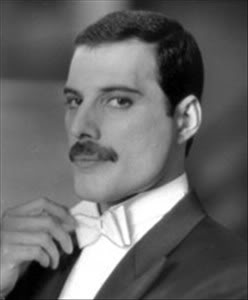
Freddie Mercury would have been 65 earlier this year. It's hard to imagine the most flamboyant of glam-rockers as a pensioner. He died 20 years ago from an AIDS-related illness, but his extraordinary musical talent endures. For the legion of Queen fans, YouTube provides heaven-sent music and video alike. Radio Gaga (with its video montage taken from Fritz Lang's classic Metropolis), I Want to Break Free, Under Pressure and the beautiful Love of my Life, the list goes on and on.
Like all those who are taken from us before their time - one thinks of James Dean, Marilyn Monroe, John Lennon and Princess Diana, among others - Freddie's image is frozen in time. Inez in Huis Clos says "One always dies too soon - or too late. And yet one's whole life is complete at that moment, with a line drawn neatly underneath it, ready for the summing-up. You are your life, and nothing else." Well, Freddie certainly packed a lot into his 45 years.
Born Farrokh Bulsara in Zanzibar in 1946 into an Indian Parsee family, he left Zanzibar at the time of the 1964 revolution (which overthrew the Sultan and his Arab/Asian government, and led to the union with Tanganyika and founding of Tanzania) and settled in the UK. His musical talent was evident from a young age as a pianist, guitarist and vocalist and, after a few flirtations with unsuccessful bands, he formed Queen in 1970 with Brian May and Roger Taylor. Queen's glory decade began with the phenomenal success of Bohemian Rhapsody in 1975 and reached a climax with their show-stopping performance at Live Aid in 1984. Freddie's ambition was for Queen to be "the Cecil B DeMille of rock n'roll" and David Mallet's Queen videos, with their use of film from the 1920s and 30s, pay homage to the glory days of cinema spectacle.
Sadly, his prodigious talent goes almost unknown in Zanzibar, apart from a sleazily-pleasant bar called Mercury's in Zanzibar town. In 2006, the Zanzibari government sanctioned a celebration of Freddie's 60th birthday, but subsequently withdrew its support of the event after an Islamic pressure group complained on the grounds that Freddie was not a true Zanzibari , that he was gay, which is not permitted under sharia law, and that"associating Mercury with Zanzibar degrades our island as a place of Islam". Freddie would have loathed this intolerance, which speaks volumes about the prevalent attitude in most African countries, regardless of the dominant religion, towards homosexuality.
The great Christian writer, CS Lewis, at the end of the chapter entitled Sexual Morality in his finest book, Mere Christianity, writes as follows: "...If anyone thinks that Christians regard unchastity as the supreme vice, then he is quite wrong. The sins of the flesh are bad, but they are the least bad of all sins. All the worst pleasures are purely spiritual: the pleasures of putting other people in the wrong, of bossing and patronising .... and backbiting; the pleasures of power, and hatred. For there are two things inside me, competing with the Human self I must try to become. They are the Animal self and the Diabolical self. The Diabolical self is the worse of the two. That is why a cold, self-righteous prig who goes regularly to church may be far nearer to hell than a prostitute. But of course, it is better to be neither."
In Uganda, anti-homosexual rhetoric is particularly virulent, to the extent that parliamentarians have called for the death penalty for practicing homosexuals, and elements of the popular press have published the names and photographs of homosexual Ugandans who dare to make their status public, and have incited violence against them. Early this year, this despicable conduct almost certainly led to the shocking murder of gay rights activist David Kato in Mukono.
Maybe, in time, a more liberal and tolerant attitude towards the ways in which adults choose to indulge their sexual pleasures will develop across the African continent. And maybe Freddie Mercury's matchless talent will be honoured by more than a tourist-targeting cocktail bar in the country of his birth.
Subscribe to:
Posts (Atom)


